



Click for more info and a larger version

Councilmembers elected by districts promote Accountability, Community, and Fairness by bringing government closer to Seattle residents.
Unlike our current system, you will have a specific Councilmember responsible to you and your neighbors. You will be able to hold them accountable for solving your issues and citywide issues.
Under the Districts 7-2 proposal, an energetic candidate can communicate directly with the people he/she will represent instead of raising hundreds of thousands of dollars. Elections will be significantly cheaper
Councilmembers elected from a specific district will be better able to advocate for public safety, parks, pedestrian safety, transporation, and road maintenance resources.

Speaker Frank Chopp
Senator Maralyn Chase
Senator David Frockt
Sen. Jeanne Kohl-Wells
Sen. Sharon Nelson
Rep. Mary Lou Dickerson
Rep. Gerry Pollet
Rep. Jessyn Farrell
Rep. Gael Tarleton
KC Councilmember Rod Dembowski
King County Democrats
King County Republicans
46th District Democrats


The Seattle 7-2 Districts Now campaign needs your help!
We need volunteers who have a couple of afternoons a month to hand out flyers at events. We have both weekend and weekday times available.
Click anywhere in this box for more information on volunteering.

We address some common questions about the 7-2 proposal.
Q: What is "7-2"?
A: This proposal will have 7 councilmembers elected by district and 2 elected at large. Hence, "7-2".
Where did the map come from?
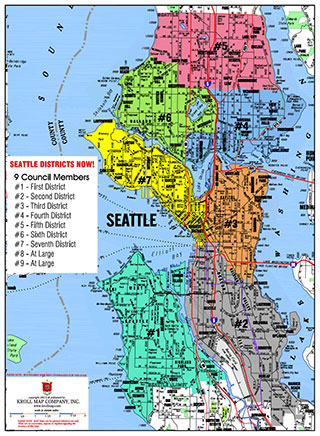
A: UW Geography Professor Emeritus Dr. Richard Morrill created the map to conform with Washington State Law -- equal population districts whose boundaries conform, where possible, to recognizable geographic boundaries.
Q: When is the first election under this map?
A: 2015.
Q: How many other major cities have district elections?
A: Almost all. Of the top 50 cities by population in the US, 47 elect all or part of their councils in geographic districts. 21 of the top 50 cities use a hybrid system like this 7-2 proposal.


The Seattle Districts Now campaign has had plenty of news coverage. Click anywhere in this box for links to our next event, our press releases, and links to articles about the 7-2 proposal.
July 16, 2013
King County Certifies Districts Initiative
June 11, 2013
Seattle Districts submits 45,000 signatures
 |
||||||
Paid for By Seattle Districts Now, Sponsored by Faye Garneau
Top 5 sponsors: Faye Garneau, Susie Burke, Ellen Taft, James Bush, James Coombes 300 Queen Anne Ave N #380, Seattle, WA 98109-4599 -- 206-526-1366 |
||||||
Download our public campaign reports at the Seattle Ethics and Elections Commission |
||||||
 |
Follow @SeaDistrictsNow | |||||